I am always interested in my patients’ back stories. We see people for a brief moment in their life, albeit often a highly significant one. Maybe a moment that will change or even save their life.
This idea of the back story, of who the patient is in the context of their life outside the hospital is something we often reflect on during Schwartz Rounds. It’s what makes our patients real people; it’s what humanises healthcare.
This was brought into sharp focus for me this week when I was caring for a three year old boy in the diphtheria centre. Through an interpreter, I asked his father to tell me a bit about his life. I’ve watched the news and heard about atrocities that take place in Rakhine province and been shocked as most people have. It’s not the same as looking someone in the eyes as he tells his story.
It’s a story of returning home from his day’s work to find his home on fire and his wife missing. A desperate search for her and the children. Finding the children but not his wife. A realisation he must leave with his four young children and their grandparents, without his wife, if any of them are to survive. Taking only what they are wearing, making the journey on foot and by boat to cross into Bangladesh and making a home from plastic sheeting and sticks.
I know that some of his words have been lost in translation. What comes across loud and clear is the emotion. The look in his eyes, the crack in his voice. There is tragedy, stoicism, great sadness. Despite it all, he is here with his son while he is treated, changing places with his mother so he can get work for a day at a time while also caring for the other children. This family have literally no possessions but the feeling of family is palpable, as is their dignity.
Their back story has made them into the people I met today. Now they have to cope with devastating disease as well as everything life has already thrown at them. I know from my experience as a nurse that human beings seem to be able to find ways to cope with the unimaginable. But I have to wonder today, when will enough be enough?
Sunday, 14 January 2018

Wednesday, 10 January 2018
Life Inside A Refugee Camp
What is life like inside a refugee camp? Before I came I had seen pictures on the news, I had watched footage taken by a drone and none of it prepared me for the reality. Aerial shots from a drone can give you a sense of scale, but they can’t tell you what it sounds like, how it smells, how it makes you feel.
 The first time I enter the camp I am shocked by the inadequacy of the shelters, the sense of disorientation, the sheer number of people. And the noise! The ground is mud. Mostly it’s hard and dry but when it rains it’s almost impassable. There are narrow tracks through which pass tuk tuks, rickshaws, the occasional minivan, cows, dogs, chickens and throngs of people.
I make the walk through the camp from clinic to clinic during the day and I am surrounded by children. Laughing, smiling, cheeky children. Some are shy and keep their distance. Some walk alongside us for a while. Some try out their few English phrases: “how are you?” “Bye bye” “ta ta” they shout amidst their giggles. They are thrilled when we we reply, and baffled when we answer with the few words we know in their language.
When I tell people I am a children’s nurse they often say how sad that must be, how upsetting to see the sick children. There are incredibly tough days, but more often than not a children’s ward is a happy place to be. Children find a way to play wherever they are and I am forever amazed at people’s ability to cope with whatever life throws at them.
These children are no different. There are numerous kites flying at various altitudes over the camp. These are made from sticks and discarded plastic bags. I don’t see toys as children at home would know them, but children have wonderful imaginations and I see them playing with stones or digging in the dirt.
 There are lines of children with distinctive turquoise unicef backpacks, heading off to school in the camp. Many are to be found in the designated ‘safe spaces for children’.
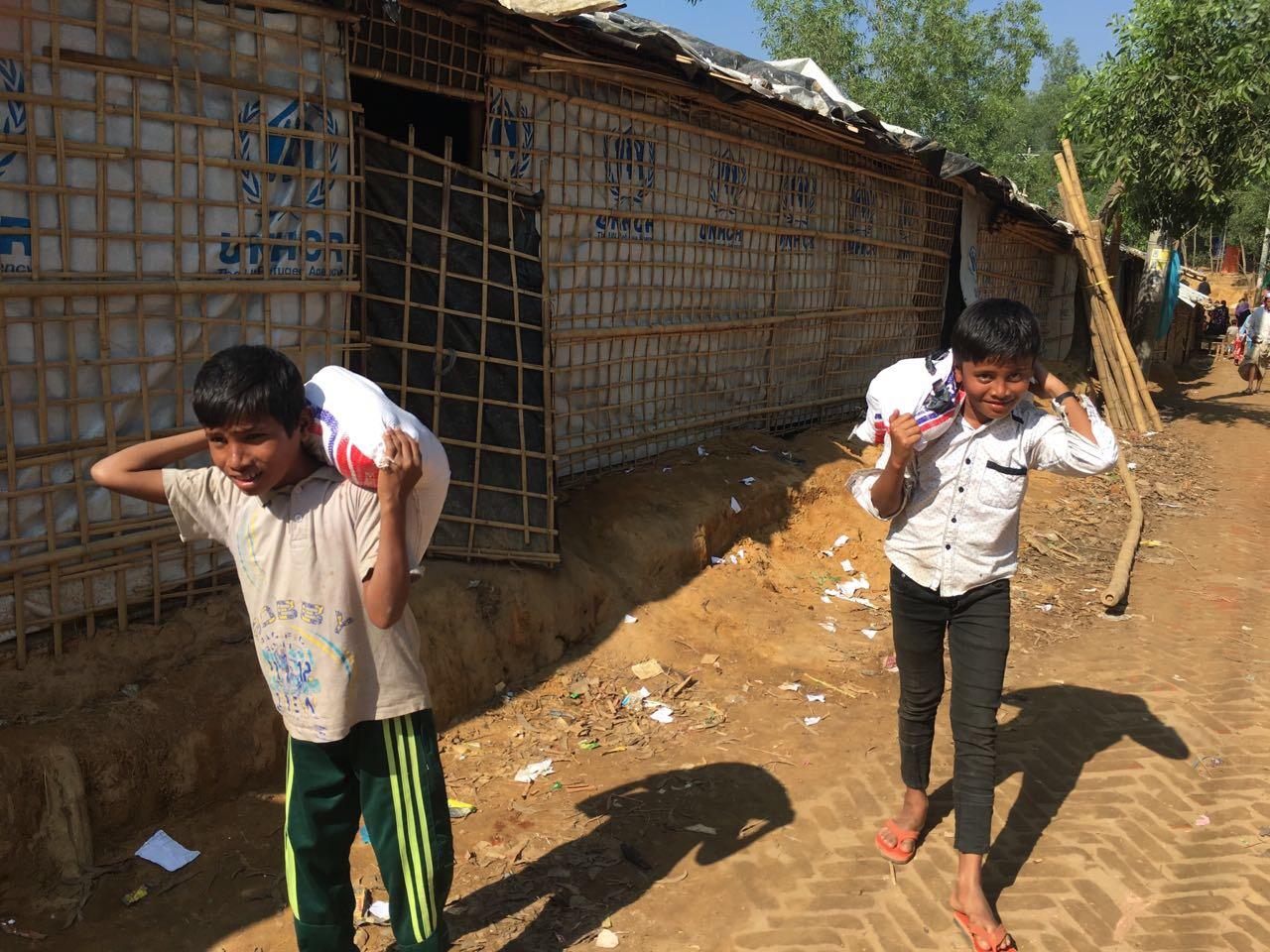
Where there is light there must also be shade. I am also well aware of the children carrying heavy loads of wood or bamboo, the boys collecting bags of rice from the food distribution line, the small children in charge of a much smaller baby. Where are their parents? Who will notice if they don’t come home? In a camp of a million refugees, where shelters are built according to no particular plan, how do you even find your way home?
We hear distressing stories about life in the camp after dark. About women afraid to leave their shelter even to go to the toilet for fear of rape. We hear about child trafficking. We hear about people living in fear.
We do what we came to do and we try to make a difference where we can, knowing that we are scratching the surface. For now, seeing a child managing to get a makeshift kite into the air, or laughing at my attempts to communicate with them in their language, will have to be enough.

 The first time I enter the camp I am shocked by the inadequacy of the shelters, the sense of disorientation, the sheer number of people. And the noise! The ground is mud. Mostly it’s hard and dry but when it rains it’s almost impassable. There are narrow tracks through which pass tuk tuks, rickshaws, the occasional minivan, cows, dogs, chickens and throngs of people.
I make the walk through the camp from clinic to clinic during the day and I am surrounded by children. Laughing, smiling, cheeky children. Some are shy and keep their distance. Some walk alongside us for a while. Some try out their few English phrases: “how are you?” “Bye bye” “ta ta” they shout amidst their giggles. They are thrilled when we we reply, and baffled when we answer with the few words we know in their language.
When I tell people I am a children’s nurse they often say how sad that must be, how upsetting to see the sick children. There are incredibly tough days, but more often than not a children’s ward is a happy place to be. Children find a way to play wherever they are and I am forever amazed at people’s ability to cope with whatever life throws at them.
These children are no different. There are numerous kites flying at various altitudes over the camp. These are made from sticks and discarded plastic bags. I don’t see toys as children at home would know them, but children have wonderful imaginations and I see them playing with stones or digging in the dirt.
 There are lines of children with distinctive turquoise unicef backpacks, heading off to school in the camp. Many are to be found in the designated ‘safe spaces for children’.
Where there is light there must also be shade. I am also well aware of the children carrying heavy loads of wood or bamboo, the boys collecting bags of rice from the food distribution line, the small children in charge of a much smaller baby. Where are their parents? Who will notice if they don’t come home? In a camp of a million refugees, where shelters are built according to no particular plan, how do you even find your way home?
We hear distressing stories about life in the camp after dark. About women afraid to leave their shelter even to go to the toilet for fear of rape. We hear about child trafficking. We hear about people living in fear.
We do what we came to do and we try to make a difference where we can, knowing that we are scratching the surface. For now, seeing a child managing to get a makeshift kite into the air, or laughing at my attempts to communicate with them in their language, will have to be enough.

Monday, 1 January 2018
My first impression of the refugee camp
I’m in the minibus with three colleagues, a small team off to the newly built DTC in the Leda camp. Emotions are running high. There’s a mix of excitement, apprehension, nerves. Will I see things that I’m not prepared for and that I can’t cope with?
We pass an elephant on the side of the road and there’s a momentary diversion from the seriousness of what we’re doing.
As we get to the outskirts of Leda, we see the Malaysian field hospital and an open truck delivering blankets to the camp. Through the trees at first, we see the refugees dwellings. I am shocked by how inadequate they look. They’re made of flimsy plastic on a frame of sticks or bamboo, pegged together. Steps in the hillside are carved from mud. It’s clear that they wouldn’t withstand much rain. Thank goodness the rainy season is a few months away.
People are queuing for a bag of food at the distribution centre. The queue is hundreds long but it’s well ordered, dignified, patient. I am amazed. Could I be that dignified if there was a chance my children would not eat?
Subscribe to:
Posts (Atom)